


In the appliance repair industry, route management is everything. Your dispatch routes are built on precise timing, geographic density, and technician availability. When a field technician calls out unexcused, the immediate aftermath isn't just an administrative headache; it’s a cascade of canceled appointments, angry customers, lost revenue, and overburdened CSRs forced to reschedule an entire day's workload.
However, business owners face a very real dilemma in today's labor market: Skilled technicians are hard to come by.
When a reliable, talented technician develops a habit of calling out, especially on high-volume days, managers often feel trapped between tolerating schedule-wrecking absenteeism or firing a tech they can’t easily replace.
If informal counseling hasn't solved the problem, here are strategic scheduling, financial, policy, and capacity-building approaches to fix chronic absenteeism before resorting to termination.
Adjust Their Schedule
When a technician repeatedly calls out on a specific day or demonstrates that they cannot reliably work a standard five-day schedule, fighting that habit week after week rarely works. Instead, re-engineer their schedule to protect your routes.
- Offer a Four-Day Compressed Workweek (e.g., 4x10s): If a tech consistently struggles with attendance on a specific weekday, transition them to a four-day schedule. Requiring four 10-hour days allows you to capture 40 billable hours while giving the technician a designated weekday off. The condition? Strict, non-negotiable attendance on their four scheduled workdays.
- Assign Route-Flexible Tasks: Stop putting high-stakes, time-sensitive residential service calls on the schedule of a tech with unpredictable attendance. Move them to shop inventory audits, shop-based sealed system teardowns, or low-priority commercial projects where a delay won't destroy direct-to-consumer customer satisfaction scores.
Implement Attendance-Based Compensation & Incentives
For technicians who value personal time over lost daily wages, simply taking an unpaid day off isn't a strong enough deterrent. To change behavior, tie attendance directly to earnings and administrative perks.
- Peak-Day Attendance Bonuses: Establish a weekly route performance or attendance bonus (e.g., $100–$150/week) that requires 100% attendance on critical dispatch days. A single unexcused absence forfeits the entire bonus for that pay period.
- Tie PTO Exhaustion to Dispatch Priority: Update your employee handbook to state that unpaid leave is not permitted if accrued Paid Time Off (PTO) is available. If a technician exhausts their PTO and takes unapproved unpaid days, establish that it directly impacts their priority dispatch status or route selection preferences.
Wage, bonus-forfeiture, and leave laws vary by state (and some absences may be protected under FMLA or ADA even when they look like a pattern). Run any compensation or PTO policy change past an employment attorney before rolling it out.
Establish Clear, Enforceable Policy Guardrails
Habitual attendance issues often persist because the boundaries between "sick time" and "unauthorized absence" are blurry. Putting explicit administrative policies in place creates necessary accountability.
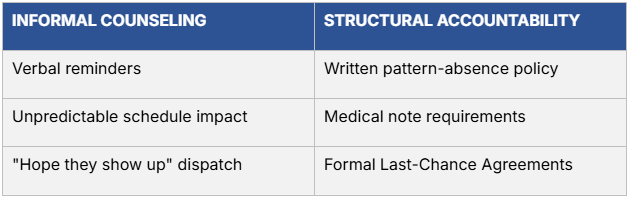
- Enforce Pattern-Absence Rules: Implement a formal policy regarding pattern absenteeism (e.g., calling out on days adjacent to weekends or holidays). Require medical documentation for any absence that falls into a clear pattern.
- Formalize Last Chance Agreements (LCAs): Move past verbal warnings. Issue a written performance agreement detailing specific attendance expectations, required notice windows (e.g., minimum 2-hour pre-shift notice), and clear consequences for future unexcused absences.
Succession Planning to Protect Your Capacity

If a technician’s attendance habits do not improve despite alternative scheduling and financial incentives, you must mitigate the risk to your business before taking final disciplinary action.
- Cross-Train Junior Techs & Apprentices: Pair a junior technician or helper with your senior tech on their active workdays. This accelerates field training for your junior staff, ensuring your shop isn't dependent on one person for specific equipment or brand expertise if you eventually have to part ways.
- Recruit Before You Replace: Never wait until a termination to post a job opening. Keep an active recruiting pipeline open so you can onboard new talent on your own schedule, rather than reacting in a crisis when a tech leaves a sudden gap in your schedule.
Protecting Team Morale and Business Growth
Allowing one technician to repeatedly disrupt the schedule without consequence sends a dangerous message to the rest of your team. Other technicians notice when colleagues bypass attendance policies, which can quickly erode team morale and operational standards.
By offering constructive schedule adjustments, implementing attendance-based financial structures, and building a solid talent pipeline, appliance repair shop managers can regain control of their daily schedules—protecting both their bottom line and their team culture.

